-
Tightly Coupled Range Inertial Odometry and Mapping with Exact Point Cloud Downsampling
This paper introduces a SLAM framework that achieves real-time CPU-only performance in dense, registration-error-minimization-based odometry and mapping by leveraging exact point cloud downsampling via coreset extraction, eliminating the need for GPU acceleration. Key Highlights Exact Point Cloud Downsampling via Coresets – Selects a minimal subset of residuals that exactly preserve the quadratic registration error function for a given pose,… →
-
NVIDIA AI Introduces Audio-SDS: A Unified Diffusion-Based Framework for Prompt-Guided Audio Synthesis and Source Separation without Specialized Datasets
Audio diffusion models have achieved high-quality speech, music, and Foley sound synthesis, yet they predominantly excel at sample generation rather than parameter optimization. Tasks like physically informed impact sound generation or prompt-driven source separation require models that can adjust explicit, interpretable parameters under structural constraints. Score Distillation Sampling (SDS)—which has powered text-to-3D and image editing… →
-
Reliability and usability of a portable spirometer compared to a laboratory spirometer
CONCLUSIONS: The portable spirometer exhibited a strong correlation and agreement with a high-quality laboratory spirometer, as well as concordance in spirometric abnormality diagnosis and severity classification. Non-specialist can obtain acceptable results using this portable spirometer. →

-
The Reliability of a Novel Structured Testing Device for Single-breath Lung Carbon Monoxide Uptake: A Randomized Comparison Crossover Study
CONCLUSION: The MeHow MeAir 9000 spirometer provides high accuracy measurements of lung diffusing capacity and reliable assessment of the severity of diffusing capacity impairment, making it suitable for clinical use. →

-
Long-term efficacy and safety of upadacitinib in patients with moderately to severely active ulcerative colitis: an interim analysis of the phase 3 U-ACTIVATE long-term extension study
BACKGROUND: The U-ACTIVATE long-term extension study aims to evaluate the long-term efficacy and safety of upadacitinib in patients with moderately to severely active ulcerative colitis. Here, we report interim results after 3 years of total treatment. →

-
This AI Paper Introduces Effective State-Size (ESS): A Metric to Quantify Memory Utilization in Sequence Models for Performance Optimization
In machine learning, sequence models are designed to process data with temporal structure, such as language, time series, or signals. These models track dependencies across time steps, making it possible to generate coherent outputs by learning from the progression of inputs. Neural architectures like recurrent neural networks and attention mechanisms manage temporal relationships through internal… →
-
LightOn AI Released GTE-ModernColBERT-v1: A Scalable Token-Level Semantic Search Model for Long-Document Retrieval and Benchmark-Leading Performance
Semantic retrieval focuses on understanding the meaning behind text rather than matching keywords, allowing systems to provide results that align with user intent. This ability is essential across domains that depend on large-scale information retrieval, such as scientific research, legal analysis, and digital assistants. Traditional keyword-based methods fail to capture the nuance of human language,… →
-
A Coding Implementation of Accelerating Active Learning Annotation with Adala and Google Gemini
In this tutorial, we’ll learn how to leverage the Adala framework to build a modular active learning pipeline for medical symptom classification. We begin by installing and verifying Adala alongside required dependencies, then integrate Google Gemini as a custom annotator to categorize symptoms into predefined medical domains. Through a simple three-iteration active learning loop, prioritizing… →
-
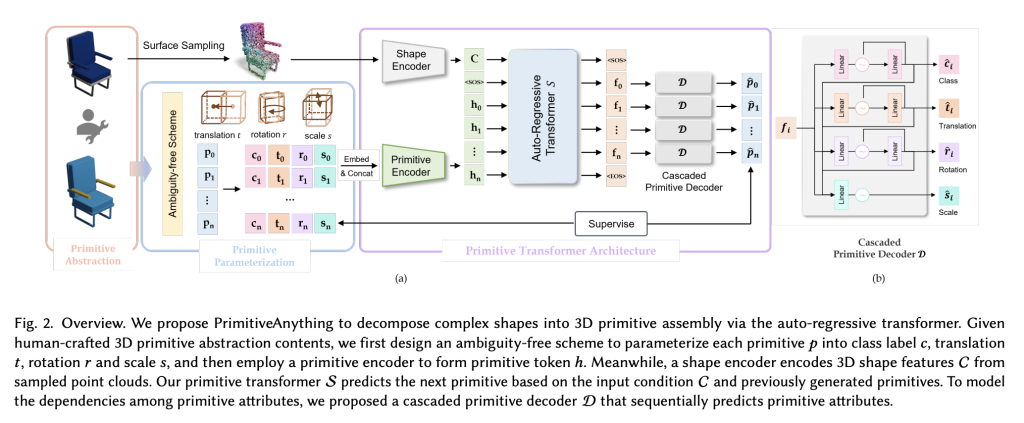
Tencent Released PrimitiveAnything: A New AI Framework That Reconstructs 3D Shapes Using Auto-Regressive Primitive Generation
Shape primitive abstraction, which breaks down complex 3D forms into simple, interpretable geometric units, is fundamental to human visual perception and has important implications for computer vision and graphics. While recent methods in 3D generation—using representations like meshes, point clouds, and neural fields—have enabled high-fidelity content creation, they often lack the semantic depth and interpretability… →
-
Study protocol of an early randomized intervention trial assessing the metabolic effects of two levels of exercise intensity in children undergoing cancer treatment: the APACIS study
BACKGROUND: Insulin sensitivity is a key factor of the development of metabolic diseases, highly prevalent in adult survivors of childhood cancers. The aim of the Adapted Physical Activity for children treated for Cancer and Insulin-Sensitivity (APACIS) study is to investigate the effects of two exercise programs started as early as diagnosis on metabolic profile and… →