AI News
Category Added in a WPeMatico Campaign
-
Meet LocAgent: Graph-Based AI Agents Transforming Code Localization for Scalable Software Maintenance…
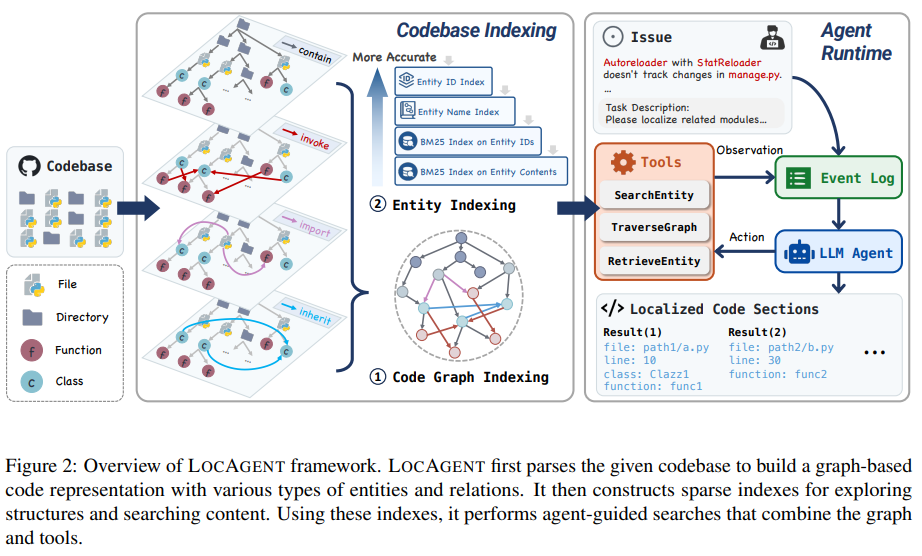
Meet LocAgent: Graph-Based AI Agents Transforming Code Localization for Scalable Software Maintenance Software maintenance is an integral part of the software development lifecycle, where developers frequently revisit existing codebases to fix bugs, implement new features, and optimize performance. A critical task in this phase is code localization, pinpointing specific locations in a codebase that must…
-
Meet LocAgent: Graph-Based AI Agents Transforming Code Localization for Scalable Software Maintenance
Software maintenance is an integral part of the software development lifecycle, where developers frequently revisit existing codebases to fix bugs, implement new features, and optimize performance. A critical task in this phase is code localization, pinpointing specific locations in a codebase that must be modified. This process has gained significance with modern software projects’ increasing…
-
A Unified Acoustic-to-Speech-to-Language Embedding Space Captures the Neural Basis of Natural Language Processing in Everyday Conversations
Language processing in the brain presents a challenge due to its inherently complex, multidimensional, and context-dependent nature. Psycholinguists have attempted to construct well-defined symbolic features and processes for domains, such as phonemes for speech analysis and part-of-speech units for syntactic structures. Despite acknowledging some cross-domain interactions, research has focused on modeling each linguistic subfield in…
-
Achieving Critical Reliability in Instruction-Following with LLMs: How to Achieve AI Customer Service That’s 100% Reliable
Ensuring reliable instruction-following in LLMs remains a critical challenge. This is particularly important in customer-facing applications, where mistakes can be costly. Traditional prompt engineering techniques fail to deliver consistent results. A more structured and managed approach is necessary to improve adherence to business rules while maintaining flexibility. This article explores key innovations, including granular atomic…
-
A Coding Implementation to Build a Conversational Research Assistant with FAISS, Langchain, Pypdf, and TinyLlama-1.1B-Chat-v1.0
RAG-powered conversational research assistants address the limitations of traditional language models by combining them with information retrieval systems. The system searches through specific knowledge bases, retrieves relevant information, and presents it conversationally with proper citations. This approach reduces hallucinations, handles domain-specific knowledge, and grounds responses in retrieved text. In this tutorial, we will demonstrate building…
-
Sea AI Lab Researchers Introduce Dr. GRPO: A Bias-Free Reinforcement Learning Method that Enhances Math Reasoning Accuracy in Large Language Models Without Inflating Responses
A critical advancement in recent times has been exploring reinforcement learning (RL) techniques to improve LLMs beyond traditional supervised fine-tuning methods. RL allows models to learn optimal responses through reward signals, enhancing their reasoning and decision-making capabilities. RL introduces a feedback-driven training loop that better aligns with human-like learning processes, particularly in tasks involving step-by-step…
-
Meta AI Researchers Introduced SWEET-RL and CollaborativeAgentBench: A Step-Wise Reinforcement Learning Framework to Train Multi-Turn Language Agents for Realistic Human-AI Collaboration Tasks
Large language models (LLMs) are rapidly transforming into autonomous agents capable of performing complex tasks that require reasoning, decision-making, and adaptability. These agents are deployed in web navigation, personal assistance, and software development. To act effectively in real-world settings, these agents must handle multi-turn interactions that span several steps or decision points. This introduces the…
-
Fin-R1: A Specialized Large Language Model for Financial Reasoning and Decision-Making
LLMs are advancing rapidly across multiple domains, yet their effectiveness in tackling complex financial problems remains an area of active investigation. The iterative development of LLMs has significantly driven the evolution of artificial intelligence toward artificial general intelligence (AGI). OpenAI’s o1 series and similar models like QwQ and Marco-o1 have improved complex reasoning capabilities by…
-
Microsoft AI Releases RD-Agent: An AI-Driven Tool for Performing R&D with LLM-based Agents
Research and development (R&D) is crucial in driving productivity, particularly in the AI era. However, conventional automation methods in R&D often lack the intelligence to handle complex research challenges and innovation-driven tasks, making them less effective than human experts. Conversely, researchers leverage deep domain knowledge to generate ideas, test hypotheses, and refine processes through iterative…
-
OpenAI Introduced Advanced Audio Models ‘gpt-4o-mini-tts’, ‘gpt-4o-transcribe’, and ‘gpt-4o-mini-transcribe’: Enhancing Real-Time Speech Synthesis and Transcription Capabilities for Developers
The accelerating growth of voice interactions in the digital space has created increasingly high user expectations for effortless, natural-sounding audio experiences. Conventional speech synthesis and transcription technologies are usually beset by latency, unnaturalness, and insufficient real-time processing, making them unsuitable for realistic, user-centric applications. In response to these essential shortcomings, OpenAI has launched a collection…