AI News
Category Added in a WPeMatico Campaign
-
Meet VoltAgent: A TypeScript AI Framework for Building and Orchestrating Scalable AI Agents
Meet VoltAgent: A TypeScript AI Framework for Building and Orchestrating Scalable AI Agents is an open-source TypeScript framework designed to streamline the creation of AI‑driven applications by offering modular building blocks and abstractions for autonomous agents. It addresses the complexity of directly working with large language models (LLMs), tool integrations, and state management by providing…
-
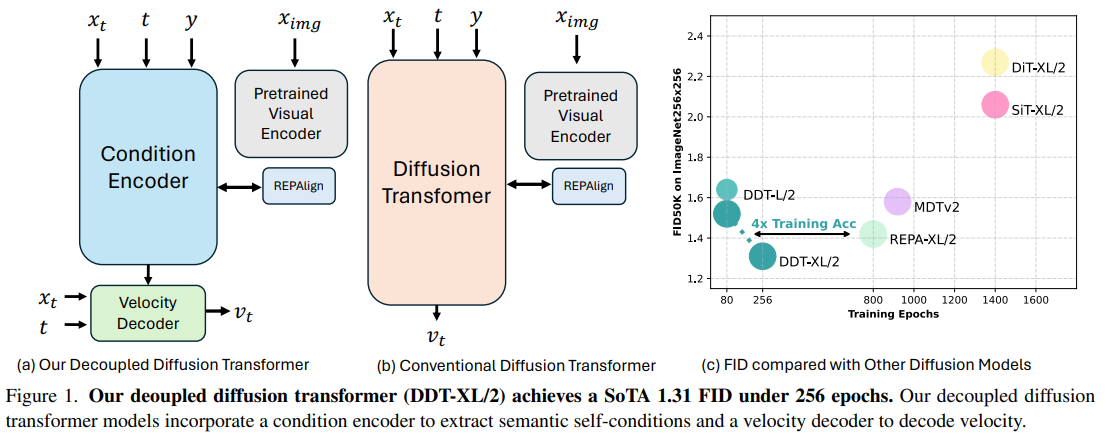
Decoupled Diffusion Transformers: Accelerating High-Fidelity Image Generation via Semantic-Detail Separation and Encoder Sharing…
Decoupled Diffusion Transformers: Accelerating High-Fidelity Image Generation via Semantic-Detail Separation and Encoder Sharing Diffusion Transformers have demonstrated outstanding performance in image generation tasks, surpassing traditional models, including GANs and autoregressive architectures. They operate by gradually adding noise to images during a forward diffusion process and then learning to reverse this process through denoising, which helps…
-

A Coding Guide to Build an Agentic AI‑Powered Asynchronous Ticketing Assistant Using PydanticAI Agents, Pydantic v2, and SQLite …
A Coding Guide to Build an Agentic AI‑Powered Asynchronous Ticketing Assistant Using PydanticAI Agents, Pydantic v2, and SQLite Database In this tutorial, we’ll build an end‑to‑end ticketing assistant powered by Agentic AI using the library. We’ll define our data rules with Pydantic v2 models, store tickets in an in‑memory SQLite database, and generate unique identifiers…
-

Atla AI Introduces the Atla MCP Server: A Local Interface of Purpose-Built LLM Judges via Model Context Protocol (MCP)…
Atla AI Introduces the Atla MCP Server: A Local Interface of Purpose-Built LLM Judges via Model Context Protocol (MCP) Reliable evaluation of large language model (LLM) outputs is a critical yet often complex aspect of AI system development. Integrating consistent and objective evaluation pipelines into existing workflows can introduce significant overhead. The addresses this by…
-

LLMs Can Now Retain High Accuracy at 2-Bit Precision: Researchers from UNC Chapel Hill Introduce TACQ, a Task-Aware Quantization…
LLMs Can Now Retain High Accuracy at 2-Bit Precision: Researchers from UNC Chapel Hill Introduce TACQ, a Task-Aware Quantization Approach that Preserves Critical Weight Circuits for Compression Without Performance Loss LLMs show impressive capabilities across numerous applications, yet they face challenges due to computational demands and memory requirements. This challenge is acute in scenarios requiring…
-
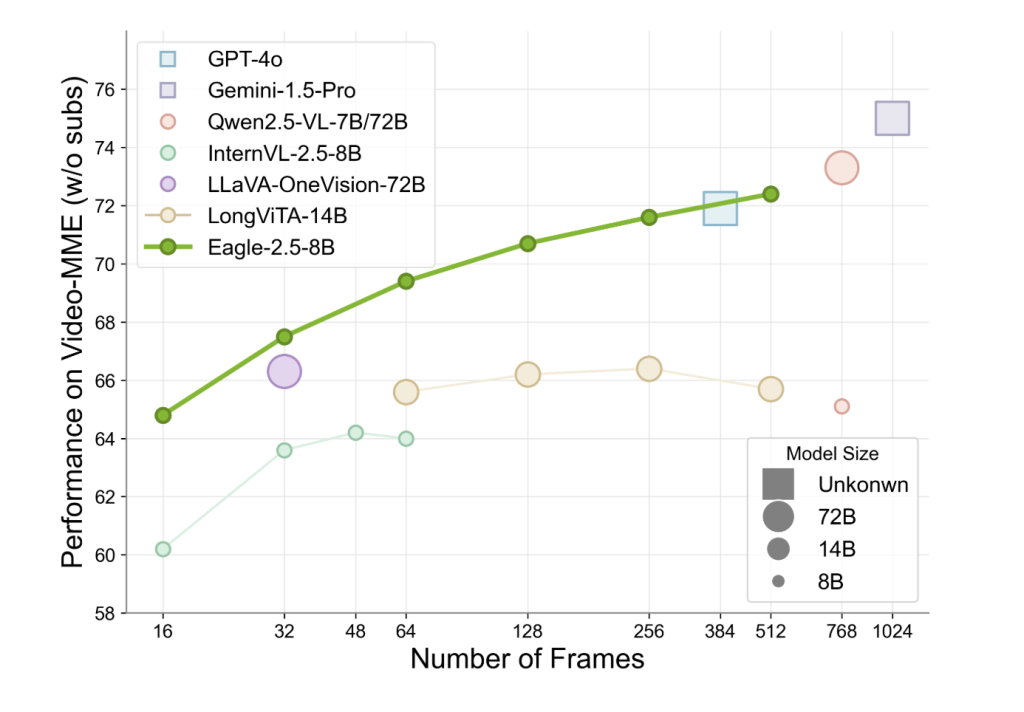
Long-Context Multimodal Understanding No Longer Requires Massive Models: NVIDIA AI Introduces Eagle 2.5, a Generalist Vision-Lan…
Long-Context Multimodal Understanding No Longer Requires Massive Models: NVIDIA AI Introduces Eagle 2.5, a Generalist Vision-Language Model that Matches GPT-4o on Video Tasks Using Just 8B Parameters In recent years, vision-language models (VLMs) have advanced significantly in bridging image, video, and textual modalities. Yet, a persistent limitation remains: the inability to effectively process long-context multimodal…
-

A Code Implementation of a Real‑Time In‑Memory Sensor Alert Pipeline in Google Colab with FastStream, RabbitMQ, TestRabbitBroker…
A Code Implementation of a Real‑Time In‑Memory Sensor Alert Pipeline in Google Colab with FastStream, RabbitMQ, TestRabbitBroker, Pydantic In this notebook, we demonstrate how to build a fully in-memory “sensor alert” pipeline in Google Colab using , a high-performance, Python-native stream processing framework, and its integration with RabbitMQ. By leveraging t’s RabbitBroker and TestRabbitBroker, we…
-
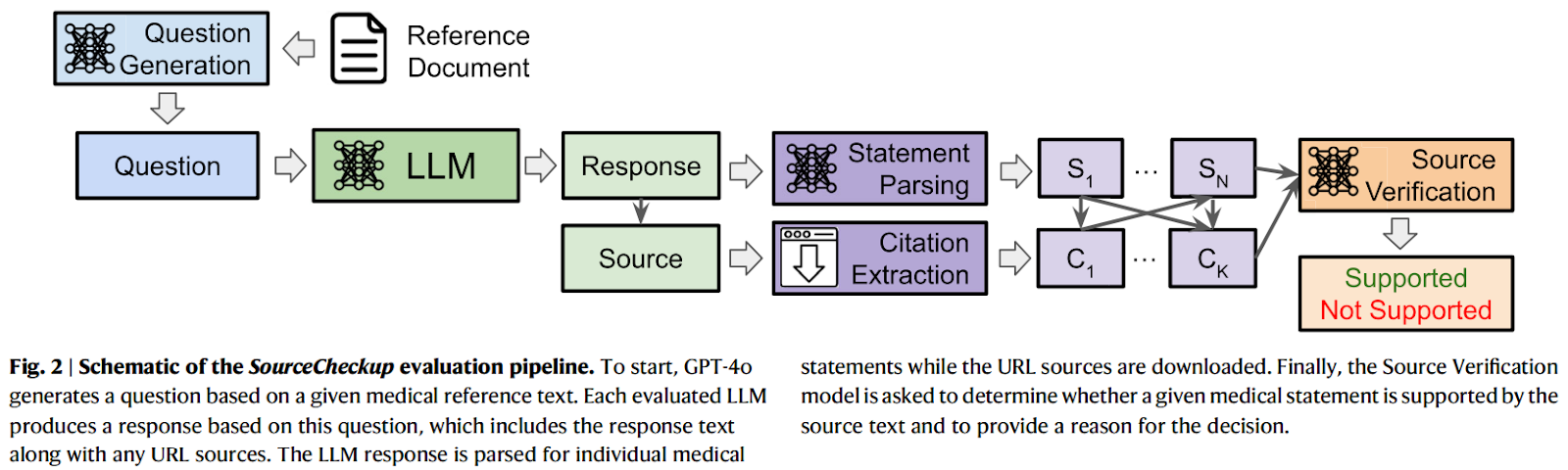
LLMs Still Struggle to Cite Medical Sources Reliably: Stanford Researchers Introduce SourceCheckup to Audit Factual Support in A…
LLMs Still Struggle to Cite Medical Sources Reliably: Stanford Researchers Introduce SourceCheckup to Audit Factual Support in AI-Generated Responses As LLMs become more prominent in healthcare settings, ensuring that credible sources back their outputs is increasingly important. Although no LLMs are yet FDA-approved for clinical decision-making, top models such as GPT-4o, Claude, and MedPaLM have…
-

Serverless MCP Brings AI-Assisted Debugging to AWS Workflows Within Modern IDEs
Serverless MCP Brings AI-Assisted Debugging to AWS Workflows Within Modern IDEs Serverless computing has significantly streamlined how developers build and deploy applications on cloud platforms like AWS. However, debugging and managing complex architectures—comprising services such as Lambda, DynamoDB, API Gateway, and IAM—often requires developers to jump between logs, dashboards, and local tooling. To address these…
-

A Step-by-Step Coding Guide to Defining Custom Model Context Protocol (MCP) Server and Client Tools with FastMCP and Integrating…
A Step-by-Step Coding Guide to Defining Custom Model Context Protocol (MCP) Server and Client Tools with FastMCP and Integrating Them into Google Gemini 2.0’s Function‑Calling Workflow In this Colab‑ready tutorial, we demonstrate how to integrate Google’s Gemini 2.0 generative AI with an in‑process Model Context Protocol (MCP) server, using FastMCP. Starting with an interactive getpass…