When workers quit their roles in garment factories, it’s a significant event, potentially disrupting supply chains and productivity. Sazid Ahmad argues that supervisor interpersonal justice—treating workers with politeness and respect or taking their side when they make a mistake—can both improve wellbeing and lower quitting intention.
Do you wish your boss treated you a little nicer, or supported you if you made mistakes? These concerns are particularly salient for garment workers in Global Supply Chains (GSC). It’s widely known that major fast fashion products are sewn in factories located in the global South at a cheap price. Since supplier factories are under pressure to cut costs and to deliver products on time, it worsens the stress of factory managers and supervisors, who in turn may verbally abuse workers to meet rising production targets.
Even though supervisor interactions are an important aspect of a worker’s experience, there is much we don’t know about their impact on export factories. Improving working conditions in these factories is now a global concern – but code compliance is a costly process. On the other hand, treating workers with justice is both inherently meaningful and “free”. This can have positive business impacts – for example lowering turnover (or quitting) intention. While supporting compliance schemes or calls for higher wages (which can lower turnover), in our recent study we explored how working experience can be improved at relatively small cost (e.g. for training) for brands or suppliers.
We conducted a study to examine how supervisor interpersonal justice (SIJ) – treating workers with politeness and respect or taking their side when they make a mistake – can lower turnover intention, and what workplace factors can influence this process. We analysed 1377 workers from 107 garment factories in Bangladesh – using data collected by Naila Kabeer and her colleagues in a previous project.
Supervisor Interpersonal Justice and Turnover Intentions – Fast and Slow Thinking
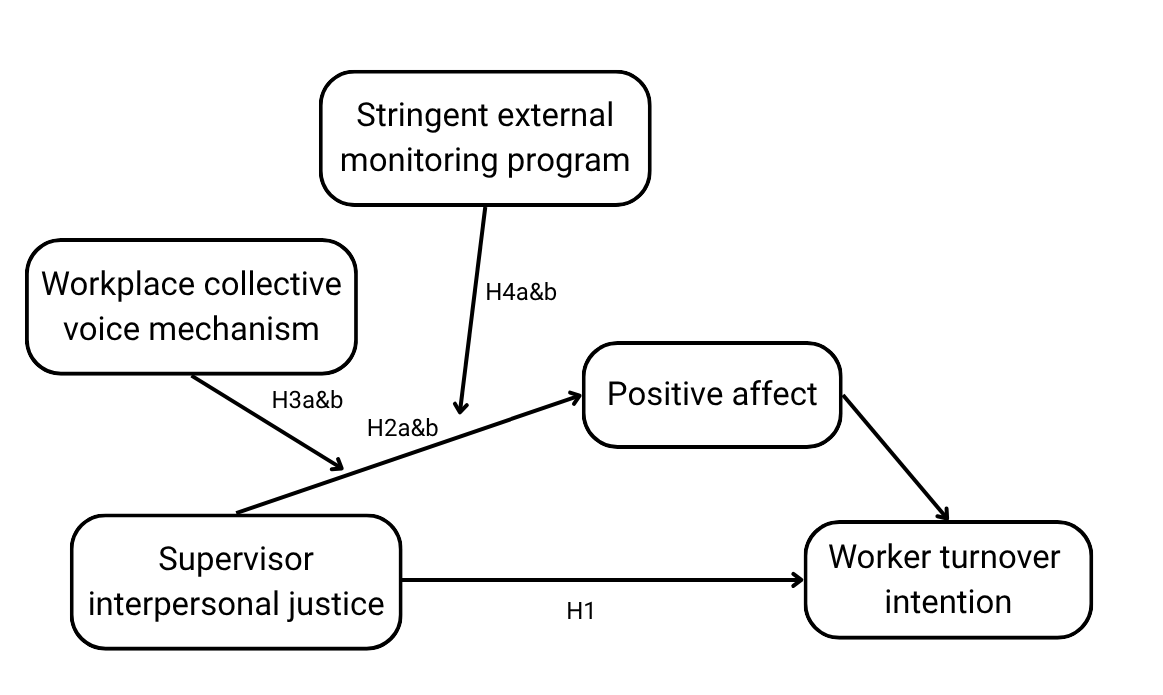
Justice is a fundamental and a subconscious human motive. We expect workers to react automatically to being treated well, a form of decision-making called “System 1” – a fast, intuitive cognition – which creates a direct relationship between SIJ and (lower) turnover intention, i.e. the desire to quit one’s job. This formed our first hypothesis, and it was supported by our primary analysis.
However, there is another, slower and more complex way to make decisions and judgments. The “System 2” cognition happens when workers show a more reasoned response to being treated with interpersonal justice, by processing their thoughts and feelings more slowly. Thus, we propose that SIJ can fulfil basic human needs like self-esteem and so boost a worker’s feeling of enthusiasm, pride, and contentedness, labelled as positive affect (H2a), and this in turn lowers their turnover intentions (H2b) as workers will prefer to stay in factories where they feel happy. This was our hypothesis 2, which was also supported by our analysis.
Together, we suggest that System 1 thinking explains a direct, and System 2 thinking explains an indirect, relationship between SIJ and turnover intentions. We expand on the System 2 thinking further below by introducing what contextual factors can influence workers’ feelings as no supplier factory operates in a vacuum. We propose two key workplace factors that can amplify the indirect relationship between SIJ and turnover intentions.
Workplace Voice Mechanisms
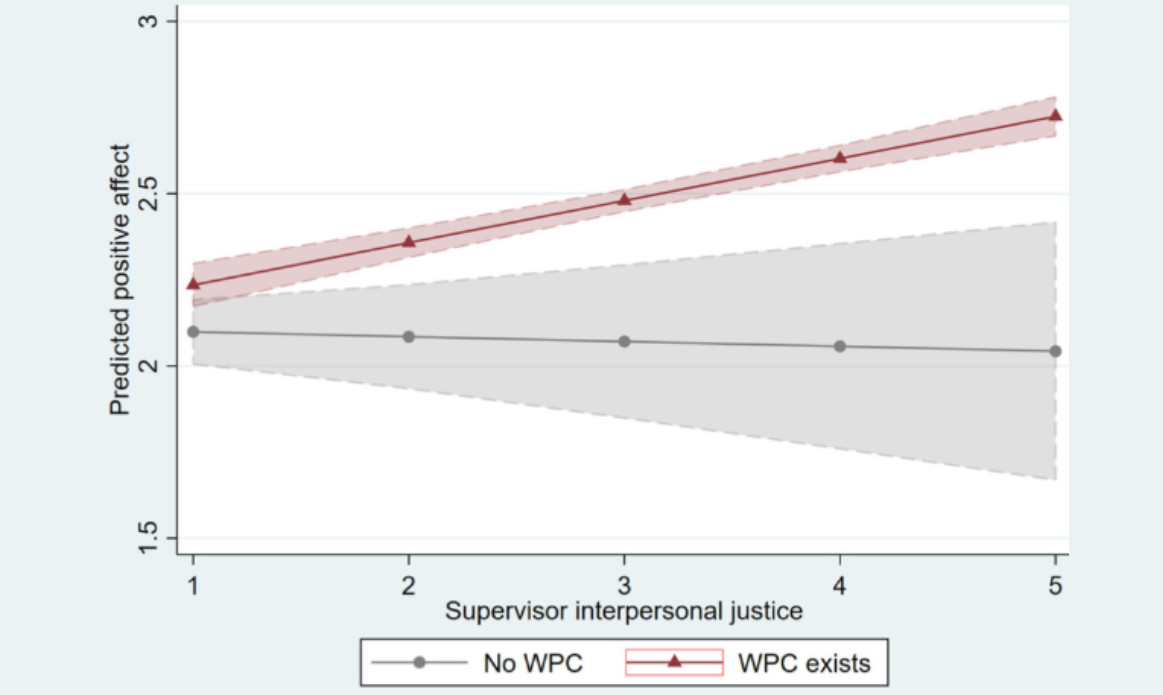
First, workplace collective voice mechanisms, such as the workers’ participation committees (WPC) in the factories. Presence of functioning WPCs themselves may prompt better SIJ since supervisors who are exposed to workers views can show more perspective-taking and humanisation of workers. But we also suggest that workers will make a more positive attribution of SIJ if WPCs are present – they may think that their supervisors responded to their collective voice and thus respect them in the way they desired. This will then strengthen how positively workers are affected by SIJ (H3a) and thus strengthening the indirect relationship between SIJ and turnover intention (H3b). Our findings supported this conclusion, and the graph below attests to stronger relationship between SIJ and positive affect in factories with WPCs than those without.
Stringent Monitoring Programmes
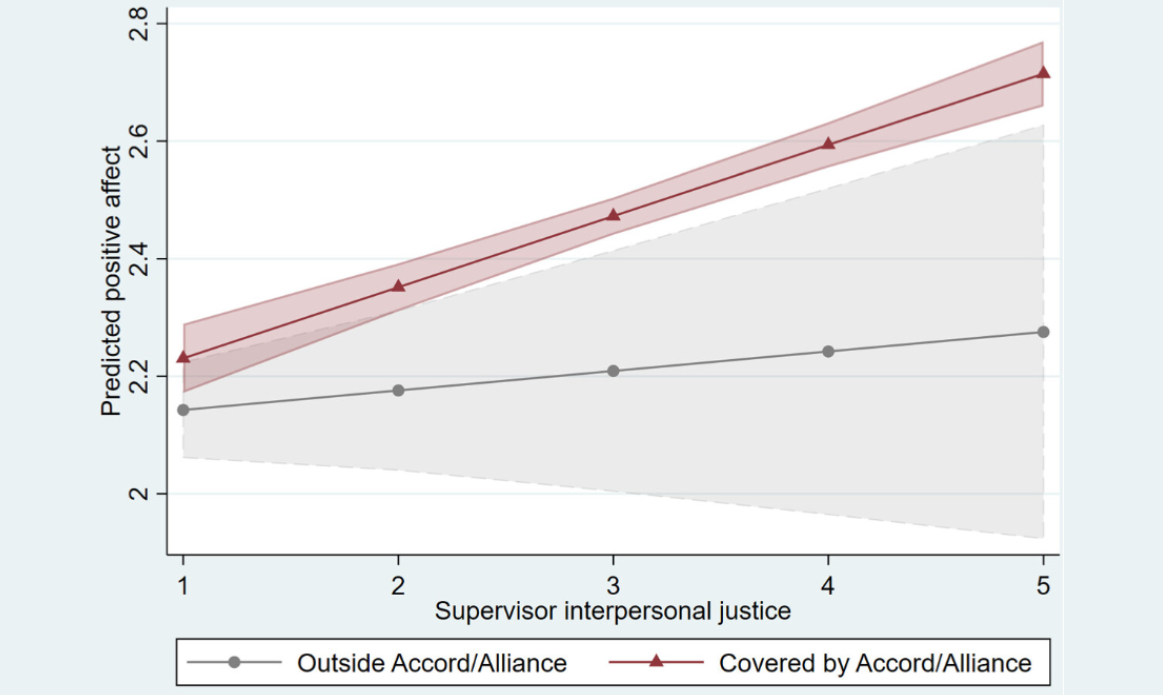
Second, we propose that stringent external monitoring institutions – for instance having comprehensive labour standards, strong enforcement mechanisms, and inclusion of societal actors like unions – may create a conducive environment for justice by lowering the strain on supervisors and making it easier to enact fair treatment. More specifically, it can contribute to workers’ perception that they have some power via these external institutions to influence supervisors’ behaviour. We hypothesised and found that factories with such institutions (in our sample the Bangladesh Accord or Alliance) would show a higher stronger relationship between SIJ and positive affect than those without (H4a). Likewise, it will promote a stronger indirect relationship between SIJ and turnover intention (H4b).
What we know, don’t know, and need to know
Our study has some weaknesses. It was based on cross-sectional data, so we couldn’t study the relationships over time. Also, we can’t rule out alternative explanations for our findings. Sensitivity tests showed only H2a (SIJ – positive affect) held up against a plausible confounder.
What we can assert for now, is that fair treatment from supervisors can improve a worker’s mental state. This by itself is already a meaningful phenomenon. Just behaviour can be good for supervisors own mental state too, which future research should explore, because abusive behaviour can make supervisors feel bad about themselves. To fully test the business case – whether in terms of actual turnover or productivity – more research needs to be done, with a better sample and research design (such as longitudinal studies).
Final thoughts: Investing in well behaved supervisors is a win-win
Worker turnover is an important event for factories, potentially disrupting business productivity. Based on the findings of our study, we invite garment suppliers to invest in training their supervisors and improving workplace culture or selecting supervisors with soft skills to treat workers justly. We also suggest that international stakeholders will benefit from paying attention to micro details of labour governance, especially the role of worker voice channels in supporting a better working environment.
- This blog post represents the views of its author(s), not the position of the London School of Economics and Political Science Department of Management.
- This blog is based on Dr Sazid Ahmad’s PhD thesis: “What workers want, what they (don’t) get, why they (don’t) want to quit: A study of Bangladeshi Garment Workers“
- Photo by Shanjir H | Photo4life AU on Unsplash.
The post Respect begets retention: Why good supervisors matter in garment export factories first appeared on LSE Management.