“Fit your own oxygen mask first” is a universally accepted safety instruction, but can the same logic be applied to leadership? Marita, Ming, Saher, Adam, Egan, and Dongsoo, argue that in high pressure environments, the ability for managers to self-regulate their own stress is a prerequisite for effective decision-making, emotional presence, and team performance.
When turbulence hits, the safety instruction is unambiguous: fit your own oxygen mask before helping those around you. Not because you matter more, but because you are useless to someone else if you are already suffocating. The same logic applies to managers in high-pressure environments. A manager who hasn’t regulated their own stress cannot think clearly, make sound decisions, nor be emotionally present for their team. Securing yourself first is not selfishness – it is a leadership prerequisite.
High-pressure industries, like investment banking, often mistake self-sacrifice for strong leadership. The manager replying to emails at midnight reads as the hardest worker in the room. But neuroscience says otherwise. Chronic stress impairs the dorsolateral prefrontal cortex, the brain region responsible for working memory, emotional regulation, and cognitive control. These are not peripheral skills, they are the exact capacities that define good leadership. Fitting your own oxygen mask first is not a distraction from the job, it is the job.
The transformational leadership framework explains why this extends beyond the individual. Through idealised influence, managers serve as emotional reference points that teams unconsciously mirror. Regulate your own stress and the team internalises calm as the norm. Neglect it, and anxiety ripples outward, consistent with emotional contagion theory. Gallup’s 2025 State of the Global Workplace report quantifies the stakes: 70% of team engagement is directly attributable to the manager. Your internal state is an organisational variable.
Self-regulation requires more than good intentions. It demands self-awareness, the right tools, and a shift in mindset. So, how do we know when we are crossing into unhealthy stress? That requires understanding the relationship between stress and performance.
Self-awareness: Finding the optimal level of stress
Stress can be defined as a particular relationship between the person and the environment that is appraised by the person as exceeding their individual resources and endangering his or her well-being.
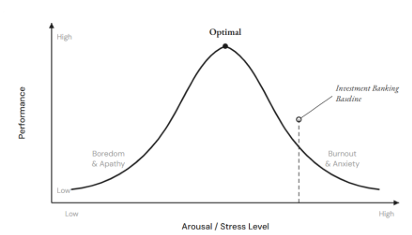
Research suggests excessive or low stress appraisal could lead to burnout and boredom respectively, negatively impacting on performance. Therefore, finding the ‘optimal’ stress level is important for performance.
This is important for managers because research also suggests self-leadership should come first to effectively lead the team, indicating positive relationship between self-leadership and people management. Therefore, finding the optimal level of stress is important for not only managers’ own performance but to effectively lead the team.
The curve in the graph above makes sense on paper. Most managers would look at it and nod, understanding there is a tipping point, and too much pressure breaks something. But the problem is almost nobody believes they have already crossed it.
A study of self-awareness across thousands of professionals found a striking gap, that 95% believed they understood their own stress patterns, while the actual figure was closer to 10%. This is not a rounding error, instead, a structural blind spot.
In fast-paced environments, this blind spot deepens. When everyone around you works late and wears exhaustion as a badge, the warning signs stop looking like warnings, they look like a job. A sleepless night becomes routine and soon your poor mood becomes everyone’s problem. Suddenly, warning signs feel like a regular Tuesday.
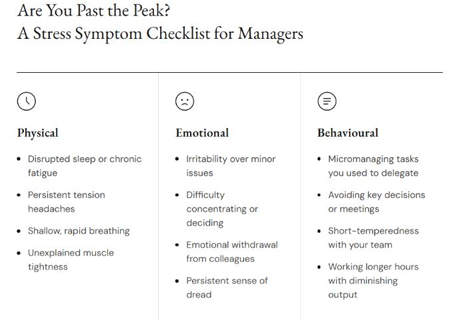
The checklist below is not a diagnostic tool but a mirror. Three or more hits and the curve is no longer theoretical.
Recognising the slide is necessary, but recognition alone does not reverse it. The harder question follows: once you know you are past the peak, how do you find your way back?
The power of positive reappraisal
There are numerous coping mechanisms available to managers from breathing exercises to tension releasers. One often overlooked is positive reappraisal, a cognitive regulation strategy where one reframes a negative or threatening situation in a positive way. Positive reappraisal is the most proactive coping tactic as it allows managers to manage their stress before it occurs.
Imagine you are a manager at an investment bank; you have an important client pitch due, but last minute, you are scheduled into a mandatory training session. What would be your initial response? For most, it would be stress about the last-minute change, because as research shows, as stress arises not from the situation but from how we appraise it.
Positive reappraisal allows managers to reframe a stressful situation into a positive situation. One way to do so is to ask reframing questions such as: What is the learning opportunity here? Can I apply lessons from similar situations here?
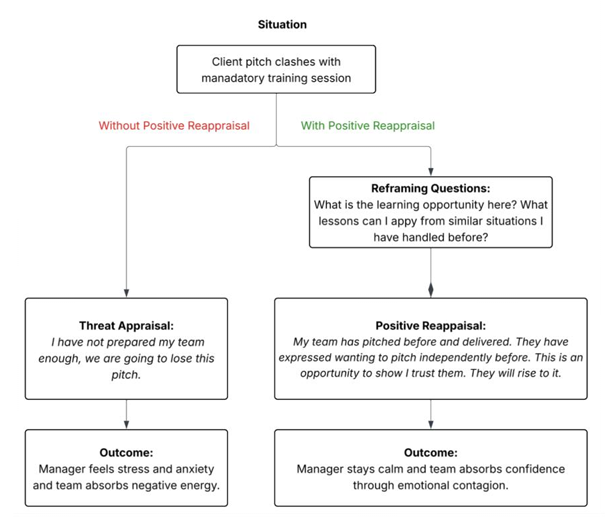
In doing so, managers can reframe a stressful situation into a challenge and build personal resilience. Lastly, through emotional contagion, a manager’s team can cope better with high-pressure environments as they model their manager’s resilient behaviour.
Key takeaways for managers
The oxygen mask instruction exists for a reason: you cannot help anyone while suffocating. For managers, self-regulation is the job.
Three principles should guide every manager:
- Regulate yourself first. Your internal state sets the tone for your team. If you’re overwhelmed, they will be too. Managing your stress is a leadership responsibility.
- Know your stress curve. Use the checklist (figure 3) as an early warning system before you pass the peak.
- Reframe, don’t just cope. Reactive strategies like sleep and exercise matter, but proactive thinking matters more. Reframe pressure into challenges. Build a calm leadership presence.
- This blog was written by students undertaking a Global Master’s in Management degree at LSE’s Department of Management as part of the MG448A Capstone Course – Management in Action.
- This blog post represents the views of its author(s), not the position of the London School of Economics and Political Science Department of Management.
- Photo by Vitaly Gariev on Unsplash
The post Fit your own mask first: Leading under pressure first appeared on LSE Management.