When the candidate in front of you lacks the specific industry experience you need, the default option is not hire them and move onto the next. However, Oliver, Jiayi, Yasaman, Marisa, Paolo, and Muhammad, argue that the managers who build the strongest teams are those willing to look beyond industry labels, and instead assess a candidate’s capacity to adapt, reflect, and grow.
If your next management vacancy attracts a candidate with the right attitude but the wrong industry on their CV, do not discard them. Rethink the job description that made you hesitate. The most impactful thing a manager can do when building a leadership team is to stop hiring for what people already know and start hiring for how quickly they can learn.
While this recommendation may sound counterintuitive, it is grounded in both research and practice. We recently attended two guest lectures with Laura Puges*, HR Director at Six Senses (IHG Hotels & Resorts), and Shaun Sinniah**, President of Reinsurance & Capital at Miller Insurance Services. In these sessions a consistent theme emerged: the managers who build the strongest teams are those willing to look beyond the industry and instead assess a candidate’s capacity to adapt, reflect, and grow.
Learning agility: The framework that should change how you hire
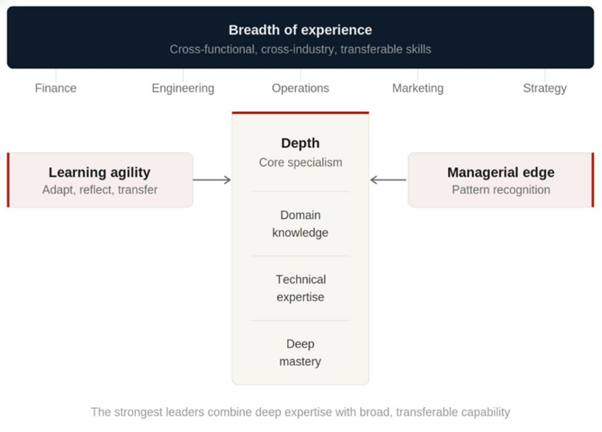
The concept that best captures this idea is learning agility: the willingness and ability to learn from experience and apply those lessons in new, first-time situations. Research identifies it as the single strongest predictor of executive potential.
Two of its dimensions matter most for managers making talent decisions. Mental agility describes the capacity to work through complex, ambiguous problems without a ready-made playbook. People agility captures the ability to communicate and collaborate effectively across diverse teams and unfamiliar contexts. Together, they suggest that what distinguishes high-performance leaders is not the depth of their technical knowledge, which can be learned, but the speed and flexibility with which they acquire new competencies when circumstances demand it.
For a manager reviewing applications, this should fundamentally alter recruitment requirements. The question shifts from “Has this person done this role before?” to “When this person encountered something unfamiliar, what did they do about it?”
Puges made exactly this point in her guest lecture, drawing on her twelve years of HR leadership across automotive technology and luxury hospitality. The candidates who stand out are not those with the most polished CVs, but those who can confidently articulate something specific.
“Here is what I do not know yet — and here is how I intend to close that gap.”
Laura Puges
This form of self-awareness, she argued, is rarer and more valuable than sector expertise. It signals the very capacity to locate gaps, take ownership of them, and build a path forward, that defines learning agility in practice.
What this looks like in practice
Shaun Sinniah’s career is a case study in learning agility at work. With an engineering background from Imperial College London, he moved into investment banking at Goldman Sachs in Hong Kong, then transitioned into the insurance sector, advancing quickly into senior management. Most recently, he was recruited by a major private equity firm to build out Miller’s global reinsurance business and strengthen its capital markets links.
This pattern is not isolated. During a private equity internship at a boutique firm in Milan, one of the authors of this blog with a materials engineering background was brought into a due diligence process alongside teams from established consultancies. With no conventional credentials for a deal room, it was precisely that technical lens that allowed him to identify production risks and scalability constraints the finance-focused team had overlooked entirely.
“The cross-disciplinary perspective exposed blind spots that a team assembled purely around domain fit could not see.”
MG488A, Private equity due diligence case, Milan – Paolo
This is the practical payoff of learning agility. It is not simply that generalists bring “different perspectives” in some vague sense. It is that people who have navigated multiple domains develop stronger pattern recognition across contexts. This is exactly why generalists consistently outperform specialists in complex, unpredictable environments.
What managers should do differently
Importantly, none of this means specialisation is worthless. In highly technical or regulated fields, depth of expertise remains essential. The argument is that specialisation is overweighted in how most organisations make talent decisions for leadership roles — and the cost is a management cohort that is technically competent but strategically inflexible.
Three actions managers could take for an immediate difference:
- Audit job descriptions. Requirements that read as gatekeeping mechanisms rather than genuine indicators of capability should be challenged. Does “five years in the sector” actually predict success, or does it unnecessarily narrow your pipeline?
- Restructure interviews to surface learning agility directly. Ask candidates to describe a time they operated outside their comfort zone. Probe for self-awareness: can they articulate what they did not know, and how they addressed it?
- Design internal development programmes that give high-potential employees cross-functional exposure rather than pushing them further down a single specialism. The compounding effect of varied experience is one of the strongest assets a future leader can carry.
The careers of both Shaun Sinniah and Laura Puges, along with the experience described above, point to the same conclusion. The most effective managers are not necessarily those who mastered one domain, but those who developed the capacity to learn across many. Managers who recognise this and adapt their hiring accordingly will build teams that are not only more capable today, but far more resilient when the context inevitably shifts.
- This blog was written by students undertaking a Global Master’s in Management degree at LSE’s Department of Management as part of the MG448A Capstone Course – Management in Action.
- This blog post represents the views of its author(s), not the position of the London School of Economics and Political Science Department of Management.
- Photo by Mina Rad on Unsplash.
- *Puges, L. (2026) Guest lecture, MG488A, London School of Economics, March 2026.
- **Sinniah, S. (2026) Guest lecture, MG488A, London School of Economics, March 2026.
The post The specialisation trap: Why your best hire might not look like one first appeared on LSE Management.