As the use of AI shifts from productivity tool to digital therapist, can it really replace human coaching? Jacinta, Katharina, Yida, Mateusz and Samsara, argue that while AI scales support, it cannot offer the ethical judgement, accountability or genuine care central to effective management.
The new age of AI has led to efficiency gains in data processing and analysis. However, research shows productivity is not the most common use, therapy is. Many people are turning to AI not to work faster but to feel better.
This insight is particularly important within the field of modern management, considering the ever-growing prominence of coaching. But what is coaching? Is it just HR’s favourite new buzzword or is it a functional practice worth implementing? Most importantly, what does AI’s newly found counsellor-esque purpose have to do with coaching and can it ever care about us well enough to coach us successfully?
AI opportunities and dangers
AI coaching seems to be a viable alternative to human coaching. In fact, theory suggests AI coaching implies efficiency gains, such as constant and instantaneous availability, no cognitive fatigue, and consistent empathy. In other words, it allows one-on-one coaching at a humanly impossible scale.
To capitalise on these efficiency gains, companies like CoachHub and Valence have developed AI-coaching models with human names: AIMY and Nadia. AIMY is marketed as the “always-on coach,” while “Nadia learns who you are, […] then delivers proactive help […] any time you ask for it.” Notably, Nadia has an impressive list of customers including Nestlé, General Mills, and Coca Cola, with a performance review from WPP’s at-the-time Chief People Officer, Lindsay Pattison, revealing that the tool is being used for “career planning, […] conversation role-play, team management and managing interpersonal relationships.”
But is this really in the interest of the employee? Is data kept anonymous? Even when data is anonymised, scholars have long argued that the ease of deanonymisation undermines these protections. The potential lack of confidentiality, therefore, threatens both the sanctity of coaching and, if employees are conscious of company access to their conversations, its efficacy.
Furthermore, AI presents serious ethical and practical dangers that make it unsuitable as a replacement for coaching. Effective coaching depends on psychological safety, ethical judgment, and adaptive challenge, conditions AI cannot reliably provide. In 2024, the family of a 16-year-old boy filed a lawsuit alleging that after months of interacting with ChatGPT for emotional support, the system engaged with his suicidal ideation rather than meaningfully redirecting him to crisis resources. The case underscores a core limitation: AI can simulate empathy, but it cannot assume responsibility.
Large language models optimise for coherent, supportive responses. Studies indicate they lack situational awareness and cannot exercise moral judgment or escalate risk appropriately. Crucially, they also lack legal and professional accountability. A human coach operates within ethical codes, professional standards, and potential liability; an AI system operates within terms of service. When harm occurs, responsibility becomes diffused. In high-stakes developmental conversations, ambiguity of accountability poses a risk.
The human nature of coaching
Managers use coaching daily: to challenge thinking, guide development, and hold people accountable. Professionals argue, psychological safety is essential, but safety without challenge is not coaching.
While AI generates options instantly, they remain generic – patterns scraped from millions of users, not insights about you.
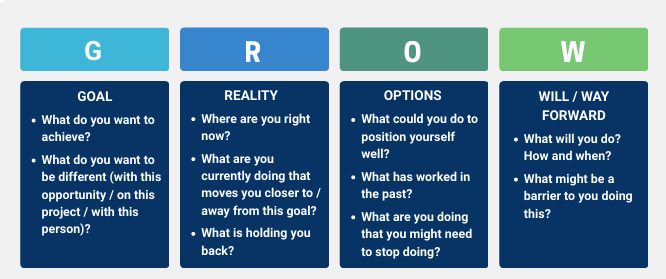
Human coaching works because people already have the answers. They just need the right questions to surface them. Frameworks like ‘GROW: Goal, Reality, Options, Will,’ give structure to that process.
However, the best coaches don’t follow a script. They move fluidly between stages, circling back, challenging people where it matters. They ask the questions that sting a little: “What are you doing right now that’s moving you away from your goal?” That’s not validation. That’s accountability.
Trust develops through authentic human connection, strengthened via consistency, genuine curiosity, and the sense that someone sincerely cares about your growth. AI doesn’t judge, but that cuts both ways: the social dynamics of appearing vulnerable in front of another person are real. We self-censor, soften, perform safer versions of ourselves. Real coaching dismantles this by creating the psychological safety for people to say the uncomfortable thing out loud in a caring relationship where the coachee does at least 80% of the talking.
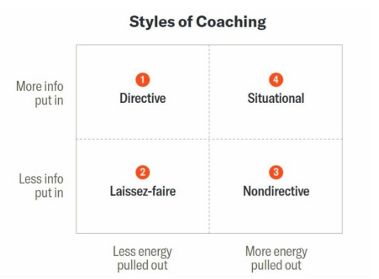
Through an iterative process and various coaching styles, solutions emerge that are genuinely specific to the individual rather than one-size-fits-all recommendations. Pay attention to repeated comments, they often reveal what matters most. Give your full time and focus. When people are told what to do, they comply; when they co-create solutions, they commit, because they helped do the work. Jennifer O’Krancy, EY-Parthenon Global Strategy and Transactions Talent Leader, appeared as a guest speaker in a Management in Action lecture and explained being a coach doesn’t just benefit others, it makes you a better leader.
Managerial context and closing remarks
The new age of AI has delivered a sentiment of perceived efficiency; yet the fact that therapy, not productivity, has become its most common use should give managers a moment to pause and reflect on what their workforce truly needs. People are not just seeking answers, they are seeking understanding, reassurance, and direction. That is where coaching truly operates.
Coaching is a leadership practice built on trust, ethical responsibility, and the ability to challenge with care. As research argues, change happens in a caring relationship. Psychological safety is essential, but it must be paired with accountability. AI can simulate the language of both. It cannot embody them.
Moreover, coaching as a practice has a net positive effect not only on the person being coached but also impacts the coach themself, as said by O’Krancy, in her guest lecture:
Being a coach “changes how you show up” and how you think about your role.
For managers deciding between deploying AI coaching tools or building a coaching culture, the real question is not just capability but also responsibility. AI cannot assume moral accountability, read the room, or carry the consequences of its guidance. Furthermore, AI cannot lead the organisation.
This is a warning to managers and coaches alike. If your coaching sounds like something ChatGPT could produce, you’re not coaching; you’re just expensive Al.
- This blog was written by students undertaking a Global Master’s in Management degree at LSE’s Department of Management as part of the MG448A Capstone Course – Management in Action.
- This blog post represents the views of its author(s), not the position of the London School of Economics and Political Science Department of Management.
- Photo by Zulfugar Karimov on Unsplash
The post Your AI coach doesn’t care about you (because it can’t) first appeared on LSE Management.