The last 50 years has seen a shift in the composition of autocratic states across the globe. However, while there is not yet exactly an economic bloc of autocratic states, along the lines of the Soviet spheres of influence between 1945 and 1990, Simon Commander and Saul Estrin argue that autocracy is alive and kicking and has been registering a growing presence in recent decades.
Autocracy is well established in much of the world. In China, the Communist Party has maintained a political lock-hold for more than 75 years and in Vietnam for more than fifty, while in Russia, President Putin has been in power for over a quarter century. In Iran, the mullahs have brutally maintained their position while the neighbouring Gulf states and Egypt also remain unequivocally authoritarian. In Africa, over 60 per cent of countries presently have a distinctly authoritarian complexion while in Latin America, authoritarian states, such as Cuba, Venezuela, El Salvador and Nicaragua continue to survive.
To the more permanent fixtures in the autocratic firmament, we have recently seen a growing number of additions. In India, Prime Minister Modi and his party, the Bharatiya Janata Party (Indian People’s Party) along with its paramilitary adjunct, the Rashtriya Swayamsevak Sangh (National Volunteer Union), have managed to erode the vitality of political competition and the independence of key institutions. In Turkey and until very recently, Hungary, the media and public institutions are largely, if not wholly, controlled by the ruler and ruling entities and their associates. While there is a façade of competition for government power, the opposition in these countries is shackled by changes to rules, access to funding, and, in the Turkish instance, imprisonment of its leaders.
Measuring the extent of autocracy
To bring data to bear in establishing the true trends, we need to ask two questions:
What constitutes autocracy?
While there is no unique format for modern autocracies, autocratic governments possess some important, common traits—not least the fusion of political and economic power. They also must decide not only how much to spend on public goods, but how much to appropriate for private rents – often indistinguishable from looting – and how much to devote to repression. Their choices have important consequences for economic performance.
How can autocracies be measured?
There are several different methods to measure regimes. You can choose to grade political systems in a binary way – a country is either democratic or authoritarian – or, as we prefer, you can use a continuous scale that allows grading a country by the degree to which it is democratic or authoritarian.
But what exactly is being measured? Unsurprisingly, there are a variety of options. Some measures try and capture multiple components of a political system, for example, the extent of media freedom, civil liberties, political participation and other features. However, there is a more limited measure which we use that captures much of the essence of a political system: namely, the degree to which free and fair elections are held.
Electoral competition
To measure electoral competition, we used the well-established Varieties of Democracy (VDem) database. It provides country scores from 10 (highly democratic) to 0 (highly authoritarian), thereby also giving a sense of the strength of a country’s political system. For example: in 2023/24, the most democratic country was Denmark (9.15) closely followed by other European states. The most autocratic was Saudi Arabia (0.015) along with Eritrea, Myanmar, and China. Countries that can be considered borderline authoritarian, with scores of between 4.5 and 5.5, include Mexico, Romania and Bulgaria.
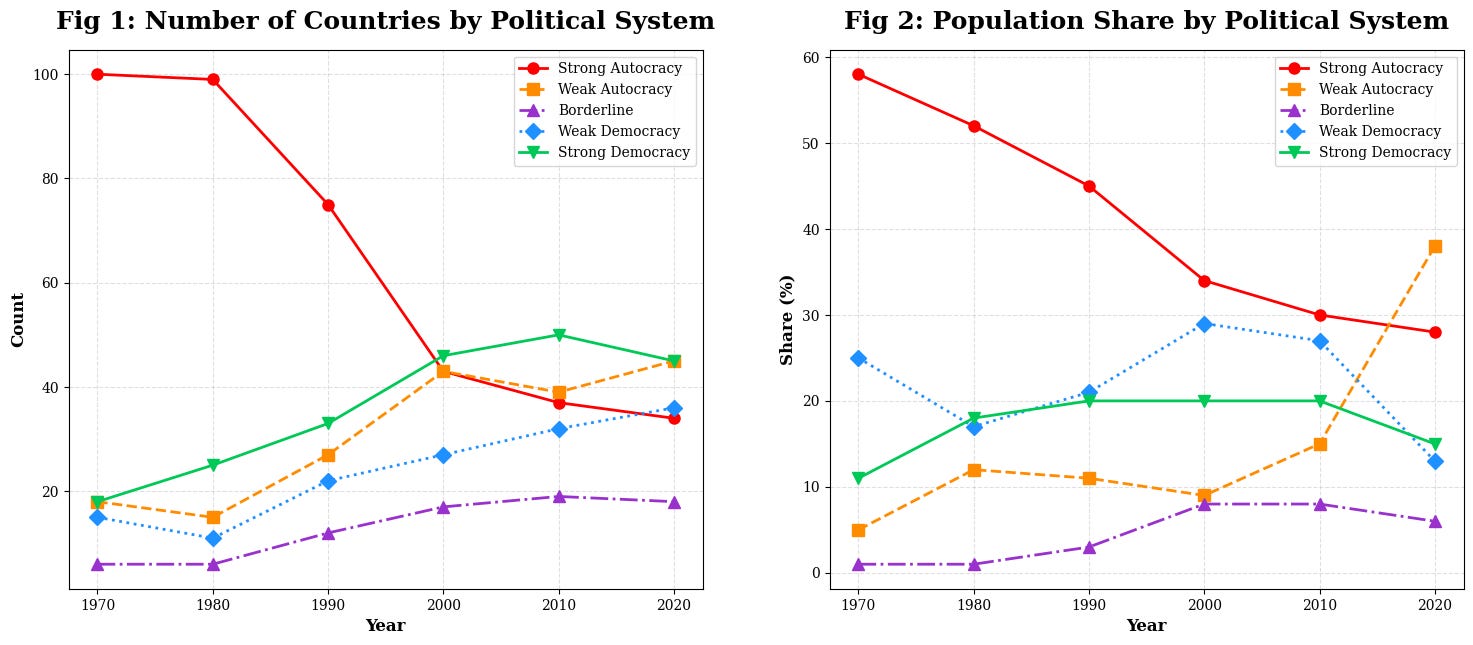
Figures 1 and 2 (below) show the number of countries grouped by political system, along with the share of the global population living under different political regimes from 1970 to 2020.
Figure 1 shows that the number of strong autocracies has declined substantially over the past fifty years, with much of that decline being due to the break-up of the Soviet Union and the wider Eastern Bloc. However, the number of weak autocracies more than doubled in the same period, as did the number of both strong and weak democracies. As a result, by 2020, the number of broadly democratic and autocratic countries was almost the same.
Figure 2 is even more striking. While the share of the global population living under strong autocracy fell by about half since 1970, there was also a very noticeable increase in the share living under weak autocracy. This means that about two thirds of the world’s population was living in some form of autocratic state in 2020 with only 28 per cent living in some form of democracy. A further 6 per cent were in borderline states.
If these are mapped, we observe well-entrenched regions of democracy, notably in Europe, North America, Japan and Australasia. Most of Latin America is also presently democratic and there are a few pockets in Africa.
However, in Asia, robust electoral democracy is a relative rarity, as it is in the lands of the former Soviet Union. An important explanation for the rising share of global population which is autocratic has been the increasingly authoritarian regime in India. We must conclude that autocracy is alive and kicking and has been registering a growing presence in recent decades.
Business implications
There is not yet exactly an economic bloc of the autocratic states, along the lines that segmented the world between the US and Soviet spheres of influence between 1945 and 1990. But we are moving in that direction. Many of the main authoritarian states, notably China, Russia, Iran and North Korea, work closely together on military and economic issues, sometimes in explicit opposition to the democratic West. The new electoral autocracies of Turkey and India may be reducing their alignment with democratic countries but are not yet firmly in the authoritarian camp.
Even so, the rise of autocracy helps to cement the fragmentation of the global economy and makes it much harder for firms to ignore geopolitical issues in their trade and international investment decisions. In particular, these governments will probably allocate more of the economic benefits, such as contracts, licenses, and market access, to politically loyal business groups in return for political support. This increased patronage is likely to distort the business and investment environment, creating an uneven playing field for foreign capital investors into these countries.
We discuss these issues further in our Posts on https://modernautocracy.substack.com
- This blog post represents the views of its author(s), not the position of the London School of Economics and Political Science Department of Management.
- Photo by yasmin peyman on Unsplash.
- Explore LSE latest Politics blogs.
The post Is the world becoming more autocratic? first appeared on LSE Management.